When it was announced that leftist Catherine Connolly had won a record-breaking vote to become the new Uachtarán na hÉireann, or President of Ireland, the pearl-clutching headlines from the British right-wing press were foreseeable. Conservative columnists seemingly vied for the most hysterical. A Spectator columnist mildly wrote, 'Catherine Connolly's election is a low for Ireland.' A Telegraph journalist penned a competitive headline, 'Keepie-uppie Connolly set to be Ireland's most divisive president.' The Daily Mail, however, outdid them with a long-winded winner: 'In voting for Catherine Connolly, the Irish Jeremy Corbyn, as president, Ireland has been gripped by political schizophrenia, accelerating its race towards woke and inevitable discord.'
Truth be told, however, Connolly is much more of a continuity candidate than these headlines would have you believe. After all, she has taken over the role from the beloved, outspoken poet-president Michael D. Higgins, who largely represents the same attitudes and values as she does. Both were affiliated with the Labour Party, are anti-NATO and committed to the stance of Irish neutrality, and also put the Irish language front and centre in their vision of the Irish cultural experience. Higgins also set the benchmark for most votes in a contested election in 2018, which Connolly has just broken. Even before Higgins, the modern history of the office began in 1990 when Labour-backed progressive Mary Robinson became the first president not to come from Fianna Fáil, the dominant political force of twentieth-century Irish politics.
The Daily Mail's outcry then appears overstated. Progressive ideals in the Áras, the presidential lodge, are not striking, but have been both standard and popular for over a decade. What is striking, however, is the contrast between who the Irish electorate chooses to be president as Head of State, a mostly symbolic role, and who they simultaneously choose to be Taoiseach, the Head of Government, and make up the Dáil, the elected parliament, which holds real political power. The past thirty years, marked by largely progressive presidents, have coexisted with thirty years of uninterrupted neoliberal administration by Ireland's two dominant neoliberal parties, Fianna Fáil and Fine Gael. The Irish government, since the Republic's inception, has only ever been led by Fianna Fáil or Fine Gael, whose differences are historical, rooted in 1920s civil war era politics that no longer differentiate them, as they now govern in a power-sharing coalition. Why is it then that what is good for the goose is not good for the gander?
Mark Fisher's framework in Capitalist Realism, whereby it is easier to imagine the end of the world than the end of capitalism, provides a useful analogy. It is possible that the Irish electorate cannot envision the end of the neoliberal consensus of Fianna Fáil and Fine Gael's duopoly; therefore, they continue to give the parties governmental mandates, despite the general agreement that both parties are failing to deliver for the Irish people. Without being able to imagine an alternative in power yet still holding the desire for one, the presidency then becomes a receptacle for expressing that longing. It is more comfortable, then, to elect a leftist president and imagine they have power than to elect them as the Taoiseach and deal with the imagined fallout of actually giving them any power.
The presidency can then be conceived of as a modern expression of the Celtic mythology's Otherworld, the Tír na nÓg, or Land of Youth: a parallel reality separated from our world by a thin veil, as somewhere that we might project our idealism without the anxiety of giving it power, choosing to live instead in a harsher reality. Such a construct represents a uniquely Irish utopian tradition, as Philip McCann wrote in the Dublin Review of Books: 'two of our most constant themes have been discontent with the present and longing for an ideal. Desire for a better future has been a marked feature of early Irish literature, with its Celtic Otherworld and Christian Heaven. Celtic culture was fertile ground for missionaries to plant ideas of Eden and Paradise because it had already developed its own culture of mythic idealism.'
That 'Celtic culture of mythic idealism' is the source from which the Irish learnt how to imagine hope, and has clearly marked political commentary to this day. Irish Times columnist Fintan O'Toole writes: 'The presiding goddess of the Irish left is a bogus aurora' that 'herald[s] a day that never breaks.' Perhaps it is precisely because that 'day never breaks' that the Irish electorate feels so comfortable making Connolly a 'presiding goddess.' In this sense, what might be even more disturbing than imagining the leftist idealism as impotent and purely symbolic is to imagine it as enabling a systematic neoliberal consensus. O'Toole himself admits, 'These impulses seem contradictory but they are in fact complementary: having a left-winger in the Arás makes the grim pragmatism of the centre-right seem just about tolerable.' O'Toole's own language of the duopoly's 'grim pragmatism' shows how the Irish might find it hard to believe in a 'realism' that does not centre capitalism.
Here, again, Fisher might help elucidate how the complementary contradictions of Ireland's political establishment are nothing idiosyncratic, but rather reflective of how capitalist realism works, by introducing the concept of 'dreamwork,' the model for capitalist realism's smooth functioning: 'When we are dreaming, we forget, but immediately forget that we have done so; since the gaps and lacunae in our memories are Photoshopped out, they do not trouble or torment us. What dreamwork does is to produce a confabulated consistency which covers over anomalies and contradictions.'
By electing leftist presidents and neoliberal governments, the electorate allows itself to project its idealism onto the Irish political establishment, whose governance does not reflect it back to us. The president becomes a pressure valve, rather than a bully pulpit, allowing for the establishment's smooth functioning, creating neoliberalism with a leftist smile.
The aim of positing Connolly as a continuity candidate is not, however, to reassure conservative columnists, but rather to encourage a culture where leftism in the presidency does not serve as a moral sanctuary, but rather a source of momentum. Fisher ended Capitalist Realism with an assertion: 'The very oppressive pervasiveness of capitalist realism means that even glimmers of alternative political and economic possibilities can have a disproportionately great effect. The tiniest event can tear a hole in the grey curtain of reaction which has marked the horizons of possibility under capitalist realism. From a situation in which nothing can happen, suddenly anything is possible again.'
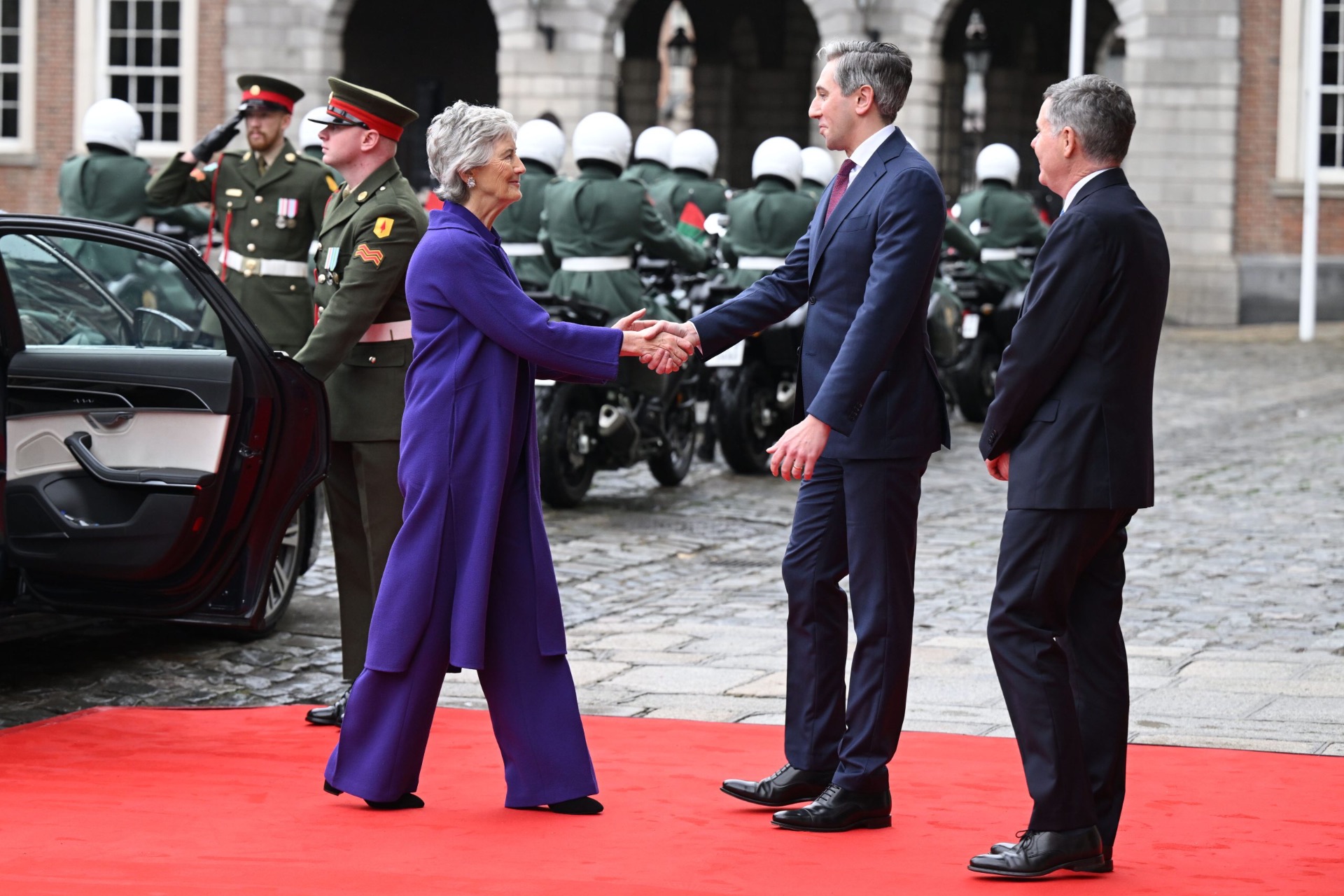
There's reason to believe that Connolly's election could be that tiny event with a disproportionate effect. In her campaign, Connolly set out as an independent, yet managed to bring together an unprecedented leftist coalition comprising Sinn Féin, the Labour Party, the Social Democrats, People Before Profit, and the Green Party, roughly outlining an alliance that could take power in the next general election. At her inauguration in Dublin Castle, that rough alliance continued, as Teachtaí Dála, or members of parliament, from these parties were sat intermingled, rather than in their party groupings. Connolly herself, in her inauguration speech, affirmed that, though the president should be a 'steady hand', it should also be 'a catalyst for change,' with the people having given her 'a powerful mandate to articulate their vision for a new republic,' indicating perhaps a renewal in Irish politics. But even if Connolly does turn out to be the political agent who turns the taken-for-granted into the up-for-grabs, she alone cannot save us. The Irish people themselves will have to learn to hope in a new way, so that the ideals we dream of in the presidency can be woken into government.