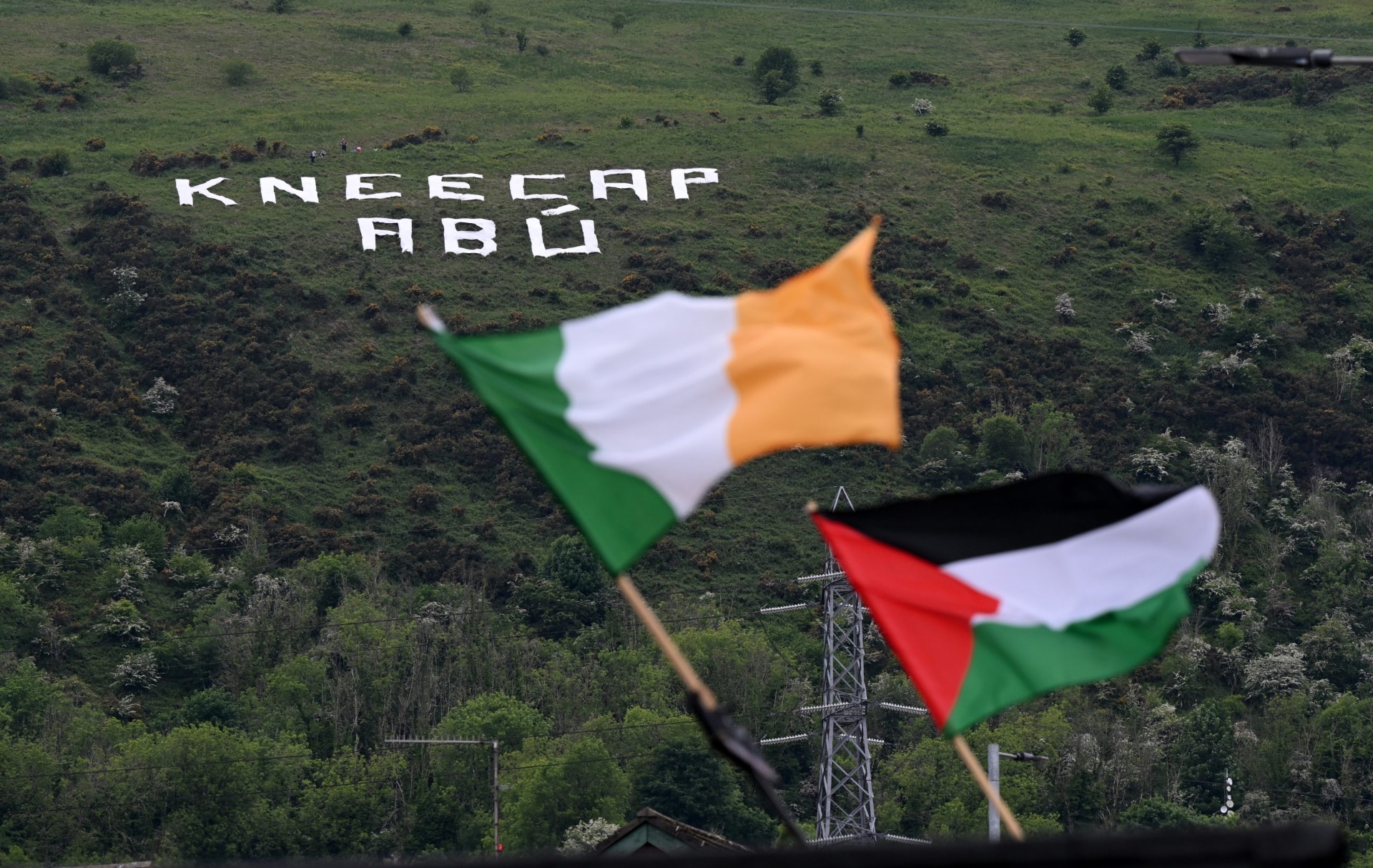
The confrontation between states and civilians is intensifying. Across the West, governments are expanding protest bans, sentencing powers, and surveillance, as lawful expressions for dissent are either outlawed or exhausted. The crackdown has meant activists are punished more severely. Just Stop Oil founder Roger Hallam was served the longest sentence for non-violent protest ever in the UK, and Palestine Action prisoners are currently undertaking the largest hunger strike since Irish Republicans refused food in 1981. As legal pathways to express dissent narrow, the scope for what is considered civil disobedience will broaden, but not all civil disobedience is created equal.
From Sophocles' Ancient Greek play Antigone to Chris Packham's documentary Is It Time to Break the Law?, civil disobedience is often framed as an act of conscience where people break unjust laws to demonstrate that those laws lack moral justification, elevating ethics over edicts. There is, however, another kind of civil disobedience that does not reject legality, but, in fact, seeks to enforce it, and that kind has been on display at Shannon Airport in Ireland.
Refuelling Genocide
For more than twenty years, anti-militarist civil disobedience in Ireland has focused on the government's decision to allow US military aircraft to use Shannon Airport. The outrage comes as the US military has used the airport as a stopover and refuelling point on their way to operations in Iraq and Afghanistan, to transit people on CIA torture planes, and now to supply Israel and the Saudi-led war in Yemen. All these activities arguably violate Ireland's commitment to neutrality, its domestic aviation and weapons regulation, and, more importantly, international law. Ireland allowing the US military to stop and refuel at Shannon is then, as one activist put it, 'literally fuelling genocide.'
Officially, the Irish government does not allow any of what is alleged to take place. On paper, any aircraft transporting arms through Irish airspace requires ministerial exemption; however, in reality, the government refuses to inspect any US aircraft, relying instead on diplomatic assurances that there are no arms inside. This policy of non-inspection allows for plausible deniability of the violations that investigative reporting suggests have been taking place for years, as the government shirks responsibility for enforcing its own standards, misunderstanding the meaning of airports as duty-free zones. The result is a politically awkward contradiction: a state that publicly affirms its opposition to unlawful war yet provides the infrastructure for those wars to be conducted.
From Activists to Auditors
In the absence of enforcement, activists have become the new auditors. The Ditch's investigative journalism has documented the alleged violations of Ireland's standards by the US military. Flight-tracking website, ShannonWarport, traces the warplanes' path to the Middle East. Palestine Action Éire, meanwhile, has repeatedly breached Shannon Airport this year, with the explicit purpose of inspecting the planes. The state has, however, responded by prosecuting Palestine Action Éire's activities, charging them with trespass, criminal damage, and disruption of airport operations. As peace activist and former Irish Defence Forces soldier Ed Horgan puts it: 'We have nine peace activists before the courts for trying to do what the Gardaí [Irish police] should be doing.' In response, the US Military Out of Shannon campaign has called for the government to: 'Inspect warplanes, not activists.'
These confrontations at Shannon Airport showcase an inversion of legality, where the act of civil disobedience lies in upholding the law, and the state prosecutes those who enforce the legal obligations it neglects.
The Branding of Legality
That inversion ties into an argument made by Noam Chomsky in his 1971 debate with Michel Foucault, where Chomsky rejected the idea that the state possesses a monopoly on legality. Just because a state can enforce a particular concept of what is legal, he argues, it does not mean that concept is the only or the correct concept. The state may define certain actions as illegal and be wrong in doing so. Importantly, his principle is based on the legal order as it currently exists, as he says: 'existing law, correctly interpreted, permits much of what the state commands you not to do.'
Chomsky offers an example drawn from anti-Vietnam War activism. The US government defined derailing an ammunition train bound for Vietnam as illegal civil disobedience. Chomsky argued that this definition was mistaken, on the basis that 'It's proper to carry out actions that will prevent the criminal acts of the state, just as it is proper to violate a traffic ordinance in order to prevent a murder.'
Chomsky uses an analogy to ground his legal argument: 'If I had stopped my car in front of a traffic light which was red, and then I drove through the red traffic light to prevent somebody from machine-gunning a group of people, of course that's not an illegal act, it's an appropriate and proper action; no sane judge would convict you.'
Ultimately, then, Chomsky concludes that 'a good deal of what the state authorities define as civil disobedience is not really civil disobedience: in fact, it's legal, obligatory behaviour in violation of the commands of the state, which may or may not be legal commands.'
In that framework, civil disobedience is not necessarily law-breaking, but rather pursuing a course of action that challenges the state's administration of legality. Disobedience to the state, then, might still be obedience to the law. That argument is not fanciful, as it has had success in courtrooms, especially in the context of civil disobedience against war crimes.
Beating Swords into Ploughshares
Chomsky's argument from the Vietnam War was actually used in Ireland during the Iraq War. At Shannon Airport in 2003, the Pitstop Ploughshares, five members of the Catholic Worker Movement, stormed the runway and damaged a US transport aircraft destined for Iraq. When they eventually went to trial, a jury acquitted all of them, determining that their disarmament action was reasonable to save lives and property in Iraq and Ireland. Chomsky's argument of proportionality, of 'violat[ing] a traffic ordinance in order to prevent a murder,' has then stood up in court.
Grounding civil disobedience in existing law offers strategic advantages over protesting the legal order on grounds of conscience alone. The familiar argument that laws may be broken because they are unjust, most famously invoked by Martin Luther King Jr. when he wrote that 'an unjust law is no law at all,' carries an undeniable moral force, but it can also appear idealistic or abstract to those outside activist circles. By contrast, the argument that the law already embodies legitimate principles, that those principles prohibit what is occurring, and that it is the state itself that is violating them, affirms a shared legal and institutional framework. In this formulation, the protester is not an outsider repudiating order but a citizen insisting that the state obey its own rules. Moral rebels are easily marginalised; citizens enforcing the law against an unlawful state strike directly at the state's claim to legitimacy.
Increasingly, it is precisely such 'model citizens' who are turning to civil disobedience, not only in Ireland but across the UK and the United States. In an era when legality itself is eroding from above, gamekeepers are becoming poachers. Former government lawyers, once tasked with defending state power, now argue that civil disobedience can be a civic responsibility. Writing in the Economist, Jack Goldsmith and Bob Bauer, who served under George W. Bush and Barack Obama, warn that much of Donald Trump's programme would be unlawful or legally dubious, yet acknowledge that intimidation and coercion are often difficult to challenge through the courts alone. In what they describe as 'darkest scenarios', they argue, the survival of democratic institutions may depend on 'responsible civic resistance'. A similar logic animates the actions of Tim Crosland, a former UK government lawyer and founder of Defend Our Juries, who was arrested for organising Palestine Action protests and has spoken of a 'duty to intervene'. When the law is abandoned by those charged with upholding it, obedience to the state can become complicity in the erosion of legality itself.
What is unfolding at Shannon Airport, then, is not a rejection of legality but a demand for its restoration. Activists behave as custodians rather than iconoclasts of a legal order that has been abandoned by the institutions that are meant to uphold it. In this sense, civil disobedience does not always stand outside authority; sometimes it stands within abandoned authority, calling the law back into force. If that inversion feels unsettling, it may be because it reveals something uncomfortable: illegality increasingly flows from the top down, and obedience, rather than resistance, has become the more radical act.