The Irish Times, 9 September 2026
Explaining an Irish funeral to my English friend
My friend struggled with the idea of an open casket in the house: ‘Is that not hard to look at?’
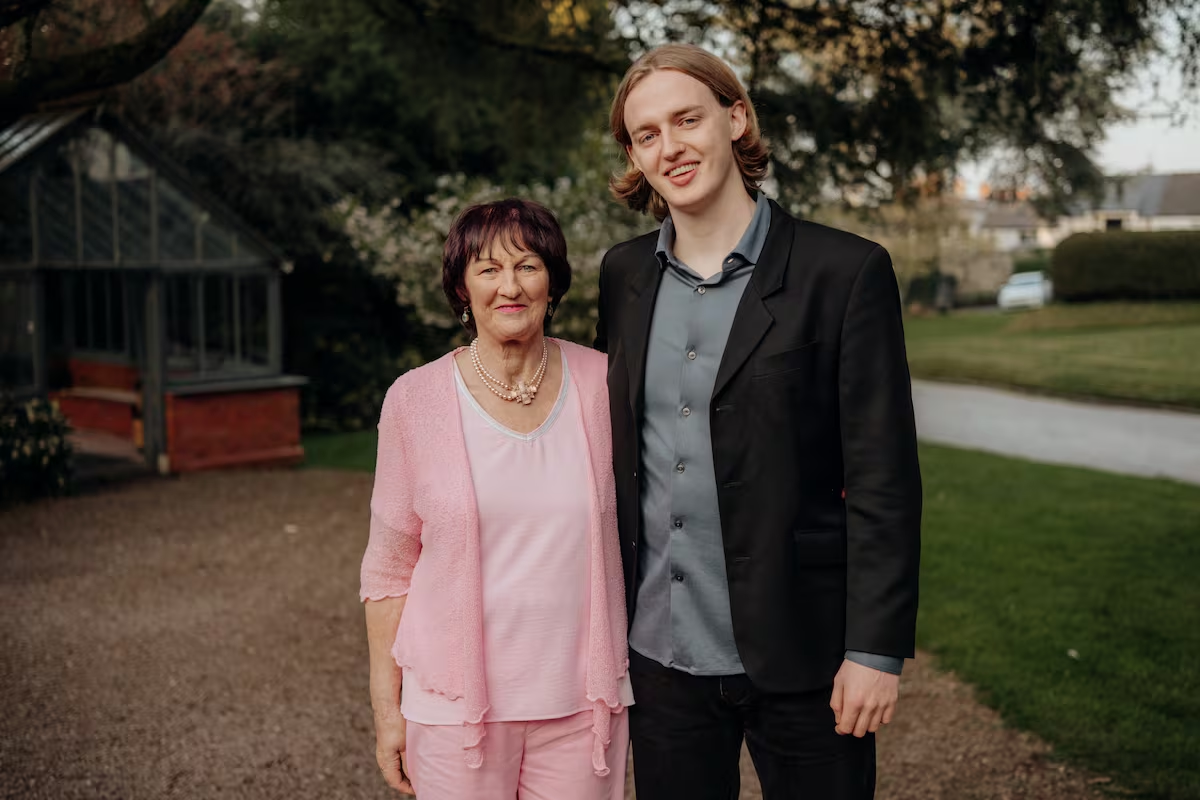
I had a call from my English friend the morning after my grandmother’s wake. She asked why I sounded so gruff. Hungover, I told her. There was a pause.
“But weren’t you at your grandmother’s family wake yesterday?” Well, exactly, I thought. Yes, I said.
“Did your whole family have a bender or something?” she asked, half-joking, half in disbelief. Fair question, I thought. Let’s see if I can actually explain this.
My grandmother had been to her own brother-in-law’s wake only a couple of weeks before she died, in Limerick. She delivered her famous rendition of The Hills of Shanagolden at the graveside in the afternoon, then drank everyone under the bar that evening.
After she died her funeral followed that familiar shape.
Her remains came home to the living room in which my grandmother had raised generations. There was no guest list. Neighbours, distant cousins, the postman, people I did not recognise, all of them were welcome to walk through the door, murmur a prayer and stand with my grandmother for a moment, see her one last time.
Twenty of us crowded into that same room hours later as the undertaker put the lid on the coffin. At Mass the next morning, the church was fuller than usual, with parishioners alongside those who hadn’t seen the inside of a church in years. At the burial, prayers that many only half-remembered, were recited as my grandmother was lowered into her grave.
And then, after the hotel lunch that followed, almost without anyone deciding it, the whole thing moved into the bar next door, where the stories started up again. My cousin asked if I’d have a drink in my grandmother’s honour, so I ordered her favourite cocktail, Sex on the Beach, which she always loved ordering for its fruity taste and risqué name.
My English friend found the drinking part bewildering. Surely a funeral isn’t meant to be some kind of party? But it was the part before that, I realised, that she actually couldn’t get past.
“Is this not a bit much?” she asked. “The body, I mean. In the living room. Is that not hard to look at?”
I told her it was hard, of course it was, but that the hardness was partly the point. Seeing her dressed in her own front room, in the place she had actually lived, and seeing she was no longer alive, was what let the whole thing become real. Seeing it was believing it.
My friend wasn’t being squeamish, I don’t think. She comes from a place where death is handled at a careful distance, and where that distance is its own kind of care: nobody is made to look at something before they’re ready, nobody’s last image of a person forced on them. I could see the sense in that, once she put it to me. I just couldn’t quite feel it.
I tried picturing her version properly, with a closed casket and a funeral arranged for whenever the family could manage it. Solemn, I thought, but only solemn. And contained, even in its seriousness.
“It isn’t really meant to have any joy about it,” she said.
“None at all?”
She thought about it. “Not really, not how you mean. You’re not supposed to look happy. Otherwise, people start to wonder whether you loved the person at all,” she told me.
That’s the bit I keep coming back to. Because the whole of what I’d just described to her, the rosary, the silence, the Mass, the burial, then the cocktails, doesn’t fit into one register.
We tell loud stories and we sit in silence. We cry and we celebrate. None of this gets rationed out in the correct order. My grandmother had just turned 80. She had three children, 12 grandchildren, two great-grandchildren and a 60-year marriage. How can all of that fit into sadness alone?
By the end of the call, my friend was still not about to change the way she planned her own family’s future funerals. We hadn’t agreed on much. We’d each worked out, a little better, what we actually believed and why. A bender, she’d called it, right at the start. A funeral, I told her. A bit of a bender, I guess. But it was so much more than either. It was our way.
Hugo Harvey is a writer and presenter from Cork who has lived across France and the UK.
Originally published in The Irish Times.