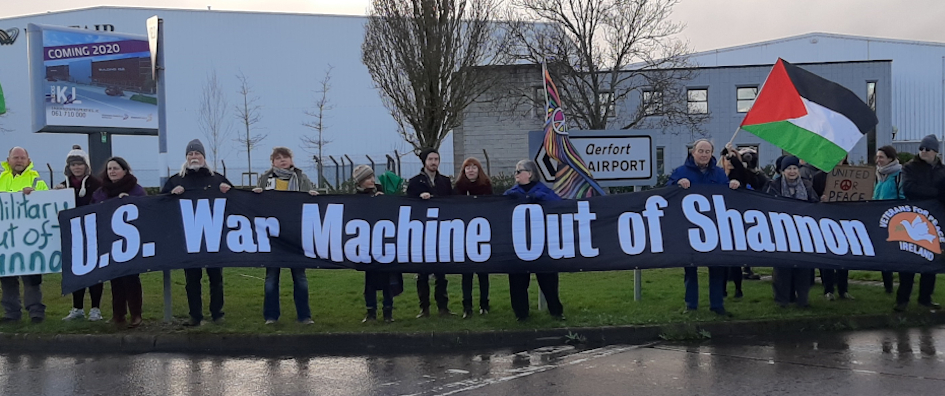
As the 'plausible genocide' in Gaza goes on, and more evidence appears of the warplanes passing through Shannon Airport, the Irish state continues to say one thing but do another. It says that Ireland is neutral, that arms only pass through its airspace with special leave, that it disapproves of unlawful war. Yet US warplanes on their way to supply Israel continue to stopover in Shannon Airport without the Irish government objecting.
The trick is an old one. The US gives the Irish 'diplomatic assurances' that their warplanes have no weapons inside them, and the Irish agree not to inspect the warplanes. If no one looks inside the hold, then there is nothing to look at. Trust, never verify.
For more than twenty years, anti-war activists have protested this arrangement. They objected when the Americans stopped over on their way to Iraq, Afghanistan and Guantanamo. They object now because they believe that US troops, arms and munitions are passing through Irish territory to support Israel destroying Gaza. Their argument is not merely that this is wicked. It is that it is unlawful, and that, while the government preaches with its lawbook in hand, it forgets what is written inside.
This is where the question changes. Usually civil disobedience means breaking a law because one thinks it unjust. What happens when the protester finds the law itself just on paper, but missing on the ground? In that case, the people climbing the fence are not resisting law, but trying to restore it.
That is the argument of those who have entered Shannon Airport to inspect aircraft. They say: the law exists, it forbids certain things, and the state fails in its duty, so we do what the state ought to have done. They do not say: law is a sham and conscience is everything. What matters is not romantic heroism, but the logic of the thing.
This sounds wild because we grow used to a topsy-turvy world in which the guardian of the law is allowed to yawn at its breach, while the citizen who points that out is handcuffed and led away. The government trades on its own terms: 'safe operations,' 'diplomatic assurances,' 'strict neutrality'; but these no longer buy them anything. The state is now breaking the law in a particularly modern way: not by roaring anarchy, but by letting procedure become a curtain.
Noam Chomsky once gave a useful example in his debate with Michel Foucault. If a train is carrying munitions to an unlawful war and someone unlawfully stops the train, it is as if someone sped past a red light to stop a murder. A sane jury would not convict them. Breaking the law to prevent a greater crime is then lawful. The state might deem an act unlawful and be wrong in doing so, especially when one understands the law as a body of rules that binds ruler and commoner alike, not any order shouted by the most powerful. Much of what is called 'civil disobedience' is then rather emergency law enforcement.
There is precedent for this. In 2003, the Pitstop Ploughshares entered Shannon to damage US military aircraft on the way to the Iraq War. They were acquitted. Around the same time, some of the Fairford Five in England were acquitted after interfering with operations for the same war. In both cases, the juries accepted that people can break small rules to stop others breaking big ones.
Not every act of sabotage is wise. Such acts may fail. They may stiffen repression. They may help the state dress itself as the victim. But there is also danger in doing nothing. When governments assist violence, inaction is not neutral. It is obedience, and obedience may be the most political act of all. The choice, then, is not between order and disorder. It is between breaking an order in the open or breaking a law with stamps, uniforms, and diplomatic smiles.
***
Critical Reflection
This piece is shaped by Orwell in both style and method. In 'Politics and the English Language' (1946), Orwell argues that political writing often uses vague or inflated language to hide reality. He also argues that clear prose is a moral act because it forces the writer and reader to face what is happening. I have tried to follow this by using plain language and concrete examples. The piece focuses on things that can be seen. Warplanes in airports, holds within planes, activists climbing fences, a law book. I avoided abstract phrases such as 'state complicity' and instead described events in direct terms.
Orwell's influence also shapes the structure of the argument. In essays such as 'The Sporting Spirit' (1945) and 'Future of a Ruined Germany' (1945), he begins with an observable fact and develops a broader claim. I follow the same method. The article begins with a contradiction. The Irish state claims neutrality but allows military transit. From this, the piece develops an argument about how modern power operates.
Orwell is also concerned with the gap between language and reality. This is central to the article. The government uses phrases such as 'safe operations' and 'diplomatic assurances'. These phrases appear stable but have lost their force. In the piece, I show how such language hides responsibility. The line that these phrases "no longer buy anything" reflects this idea.
Finally, the argument reflects Orwell's focus on clarity and logic. The piece examines a tradition of civil disobedience in Shannon Airport which itself emphasises consistent application of an international logic, rather than simply individuals acting out of their own conscience. The aim was to make the argument clear rather than decorative.
'Nothing to Report at Shannon Airport' by Hugo Harvey is the winner of the political column category of the Orwell Society/National Union of Journalists Young Journalist Awards 2026.